MOGU MOGU — Build Your Bento, Wrapped in Furoshiki
A Japanese lunch kitchen's ordering page where a wooden lazy susan turns to bring each course round, chopsticks carry every pick into a red lacquer bento box, and the finished box is lidded and tied up in a furoshiki before checkout.
A one-screen ordering site for a Japanese bento kitchen, built in plain HTML, CSS and JavaScript with no build step. Past a deep blue intro gate that preloads every dish, a red lacquer bento tray with six compartments sits in front of a wall of loud Japanese lunch posters, and the whole table leans gently toward your pointer. To the left, a big wooden lazy susan holds eighteen bowls; each step turns it so that step's three choices swing round to face the box, with their names and prices staying upright as the wood turns. Click a bowl, drag it into the box or press 1 to 3, and a pair of chopsticks carries the food along an arc into its compartment, where it pops in with a puff of crumbs in its own colours, steams if it is hot, and repeats across wide compartments the way gyoza or pickles would sit in a real box. A yellow step card names what comes next ("Rice or noodles?", "Pick your crunch", "Something green"), a status line reports every move, and a paper receipt fills line by line, counts up the total and prints a barcode. Chef's pick fills the whole box for you, Undo walks back through every change, and clicking a compartment jumps back to it. When all six are full, "Pack my bento" drops a black and gold lacquer lid onto the box, spreads a navy wave-pattern furoshiki underneath, folds its four corners over in real 3D and ties them into a knot, then opens a delivery or pickup checkout with validation, a confirmation and confetti. Close the checkout early and the box unwraps so you can keep editing. A chopsticks cursor, optional synthesised sound and reduced-motion support come with it, and on phones the same scene stacks into a tall scrolling layout with the box on top and the turntable below.
Paste the prompt intoClaude CodeCursorAntigravityWindsurfLovableBoltv0
What's in the source
26 files — one self-contained page that opens in a browser, with the prompt that made it.
mogu-mogu-bento/
├─ img/  19 files
├─ shared/  2 files
├─ PROMPT.md
├─ index.html
└─ … 3 more
How to run this
Works the same on Windows, macOS and Linux. No prior setup beyond Node.js, and nothing to configure — the pack runs as-is.
- Built with
- HTML, CSS & JavaScript
- Requires
- Node.js 18 or newer
- Opens at
- http://localhost:3000
Note — No build step: serve the folder with any static server (for example npx serve .), since ES modules need http rather than file://. Fonts load from Google Fonts, so it needs an internet connection to look right.
✦ Or let an AI agent set it up for you
Already using Claude Code, Antigravity, Cursor or Windsurf? Unzip the pack, open the folder as a project, and just ask:
Install the dependencies and run this project, then give me the URL
It reads the README included in the pack, runs the right commands for this project, and sorts out anything that trips along the way. You still need Node.js installed (step 1 below) — everything after that it can handle.
Or run it yourself
- 1
Install Node.js, if you don't have it
Download the LTS build from nodejs.org and run the installer — on Windows and Mac it handles everything. Mac users with Homebrew can run
brew install nodeinstead.To check it worked, run
node --version. It should print a number like v22.11.0. - 2
Unzip the pack, then open a terminal inside the folder
Windows: open the unzipped folder in File Explorer, click the address bar, type
powershelland press Enter.Mac: press Cmd+Space, type terminal, press Enter. Then type
cd(with a trailing space) and drag the unzipped folder onto the terminal window — it fills in the path for you. Press Enter. - 3
Start it
Run
npx serve .— npx downloads the little server on demand, so there is nothing to install first.Then open http://localhost:3000 in your browser. Leave the terminal open while you use it — closing it stops the site. Press Ctrl+C in the terminal to stop.
+ − If something goes wrong
- “npm is not recognised” / “command not found: npm”
- Node.js isn’t installed, or the terminal was open before you installed it. Close the terminal, open a new one, and try again.
- “Port 3000 is already in use”
- Something else is running there — often a previous copy of this site. Close the other terminal, or stop it with Ctrl+C.
- The page loads but images or video are missing
- Make sure you ran the command from inside the unzipped MOGU MOGU — Build Your Bento, Wrapped in Furoshiki folder itself, not the folder containing it.
Still stuck? Email us and we'll get it running with you.
Questions about MOGU MOGU
Who is MOGU MOGU for?
MOGU MOGU is for restaurants, and for the designers, developers and agencies who build their sites. It's a foundation rather than a site for one business: ask your AI to make it about yours and it rewrites the copy, colours and images around the same build.
What is MOGU MOGU built with?
MOGU MOGU is built with HTML/CSS/JS. The source is a single HTML file: open it in a browser and it runs, with no build step. The prompt is written for coding agents such as Claude Code, Cursor and Antigravity.
Can I use MOGU MOGU for a client project?
Yes. Every purchase includes a commercial licence: use it in your own projects and in work you deliver to clients, including paid client work, change and rebrand it, and publish the result with no credit needed. What you can't do is resell, share or republish the prompt or the source files themselves.
Should I buy the prompt or the source?
The prompt is the written brief that built the design: paste it into a coding agent such as Claude Code, Cursor or Antigravity and it builds the site on your computer, which you then refine. The source is the finished project itself, ready to run exactly as the preview shows. The source always includes the prompt.
Will the prompt give me exactly the preview?
Not exactly, and that's expected. A prompt is a starting point: AI output varies between tools and between runs, so plan to refine spacing, timing and copy. The source pack is the preview itself, finished and running.
Can I get a refund?
Single designs are final once delivered, unless something is wrong on our side: a broken or empty download, a pack that isn't what its page describes, or a double charge. Then email support@brandmotion.in with your receipt and we fix it or refund it. The full terms are on the refunds page.
More like this
Browse the store →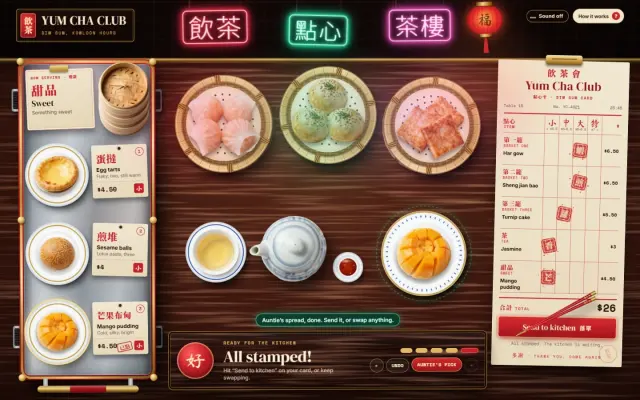 Premium
YUM CHA CLUB — Dim Sum Off Auntie's Trolley
Build a Cantonese dim sum spread in a neon-lit Kowloon tea house: pick three bamboo baskets, a pot of tea and something sweet off a rolling trolley, get a red chop stamped for every pick, and send a steaming tower of steamers to the kitchen.
 Premium
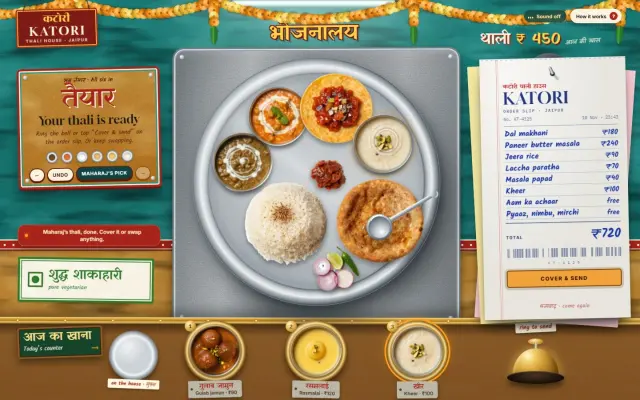
KATORI — Build a Steel Thali at a Jaipur Dhaba
An interactive ordering site where guests build a vegetarian thali katori by katori, served by a steel ladle, then cover it with a 3D dome, ring the bell and send it to the kitchen.
 Premium
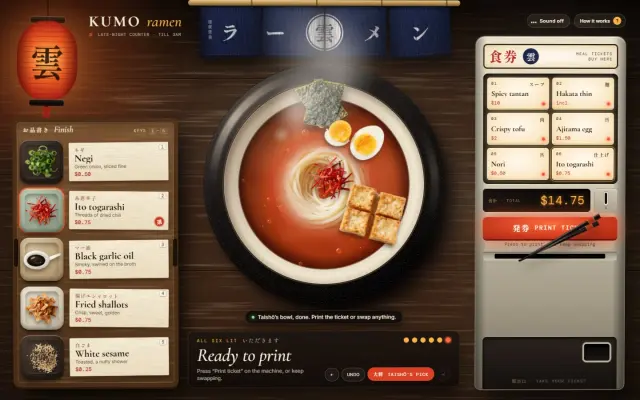
KUMO — A Late-Night Ramen Counter, Built Bowl by Bowl
A one-screen ramen builder where the broth is alive: fat droplets drift and merge, the surface swirls, and every topping lands with a ripple. Pick six things, buy your ticket from the machine, and the bowl goes out under a kraft lid.